
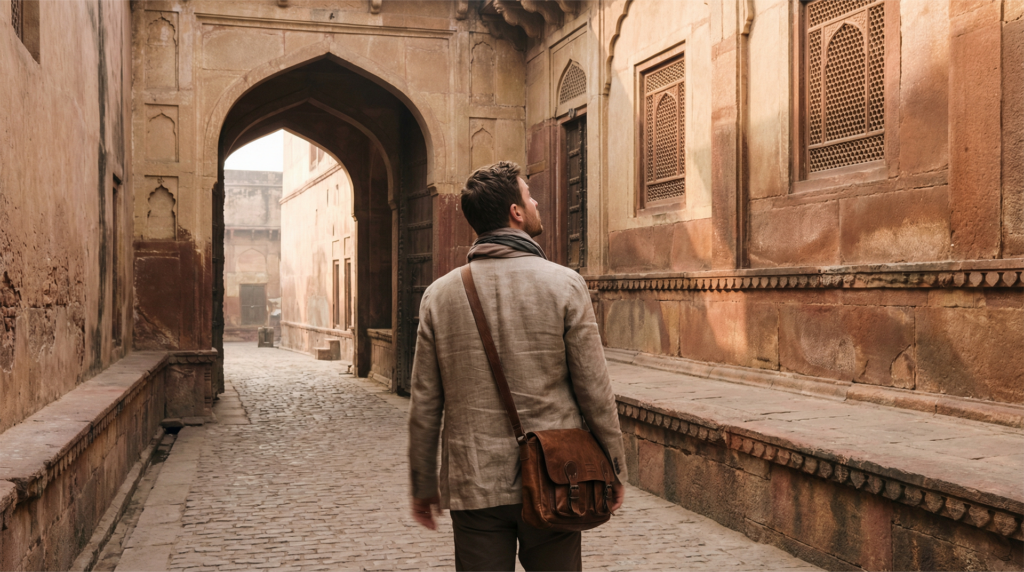
While the Taj Mahal draws the world’s attention, the broader architectural narrative of the Mughal Empire is found in Agra’s lesser-known monuments. These “hidden gems” offer a more nuanced understanding of the evolution of Persian influence and Indian craftsmanship, providing a tranquil alternative to the city’s more famous landmarks. For the discerning traveler, these sites represent the “Prime Heritage” philosophy of HHW Hotels—the selection of locations that are culturally rich and provide effortless access to the destination’s soul. If you’re looking to explore hidden gems in Agra beyond the Taj Mahal, the city offers several lesser-known yet breathtaking heritage sites
Chini Ka Rauza: A Hidden Gem in Agra with Persian Tile Art
One of the most unique and under-visited sites is Chini Ka Rauza, the tomb of Allama Afzal Khan, a trusted advisor and poet-scholar in the court of Shah Jahan. Constructed in 1635, this riverside monument is a masterpiece of Persian aesthetic, distinguished by its extensive use of glazed tile work—a rarity in Indian architecture.
The monument was named after the “Chini mitti” or Chinese porcelain used in its construction. As you wander through the tomb, your eyes feast on a field of glazed tiles in vibrant hues of blue, orange, and green, meticulously placed to create intricate floral and geometric patterns. Though time has dulled its former splendor, the central dome still retains a breathtaking patchwork of turquoise and gold. The walls are adorned with Quranic calligraphy in soothing blue, reflecting the artistic subtleties of the era. Surrounded by a Charbagh-style garden overlooking the Yamuna, Chini Ka Rauza provides a quiet space for contemplation away from the city’s urban intensity.
Itimad-ud-Daulah (Baby Taj): A Must-Visit Hidden Gem in Agra
Similarly, the Itimad-ud-Daulah’s Tomb, frequently referred to as the “Baby Taj,” provides a vital historical link in the evolution of Mughal architecture. Built between 1622 and 1628 by Empress Nur Jahan for her father, it was the first Mughal structure to utilize white marble with extensive pietra dura inlay—the technique of inlaying semi-precious stones into marble.
Its delicate lattice work and peaceful riverfront gardens often provide a more intimate experience than the larger monuments, allowing visitors to appreciate the intricate craftsmanship without the pressure of crowds. The tomb’s interior is a kaleidoscope of color, featuring wall paintings and stone carvings that served as a precursor to the grandeur of the Taj Mahal. To stand within its central chamber is to witness the transition from the red sandstone of the Akbari period to the marble elegance of the Shah Jahani era.
Anguri Bagh in Agra Fort: A Peaceful Mughal Garden Experience
Within the red sandstone walls of the Agra Fort, the Anguri Bagh (Grape Garden) offers another sanctuary of refined history. Once the private garden for the royal women of the Mughal court, its geometric design and white-limestone-covered sandstone buildings illustrate the delicate lifestyle of the imperial family.
The garden is divided into small, intricately designed plots that were once used to grow grapes and flowers for the royal kitchens. Walking through its pathways, one can imagine the “clacking” of royal slippers on the stone and the soft whispers of political intrigue that once filled the air. The garden’s proximity to the Sheesh Mahal (Mirror Palace) and the Khas Mahal makes it a central piece of the fort’s residential complex, emphasizing the Mughal obsession with bringing nature into the heart of their architectural designs.
Luxury Stay in Agra Near Heritage Sites: HHW Hotel Experience
Choosing HHW Hotel Agra as a base for this historical exploration provides logistical ease and premium comfort. The property is centrally located, allowing for short commutes to both the major landmarks and these offbeat sites. This strategic positioning ensures that guests can spend more time immersed in history and less time navigating city traffic.
After a day of traversing the old city’s alleys and royal gardens, the hotel’s classic rooms—equipped with LED TVs, central air conditioning, and a selection of mini-bar options—offer a refined home-away-from-home feel. This supports the “Sustainable Elegance” philosophy of HHW Hotels, where luxury is not just about opulence, but about the integrity of the experience and the warmth of genuine connection.
